skip to main |
skip to sidebar
Habari zenu? What news of you all? We are back in Nairobi, which means our time here in Kenya is very near its end. This being a blog, us being bloggers, today being at the end of a period of time, we feel obligated to sum up the past two months with our very first "Best Of" List. We just couldn't rank the winners in some of these categories. Other categories, clearly, deserve only one nominee.
Be warned. This one's gotten long. And away we go...
Best New Friends
- Philip & Robina- We've described already the generous hospitality shown us by our favorite double date companions. Philip & I accomplished more in the last few weeks than either of us reasonably hoped for at the outset of our project. I have really enjoyed our work together thus far and think we share the understanding that this will be the first of many joint projects to come. Robina was endlessly tolerant of my presence in Philip's room into the late hours and more endlessly gracious in taking care of me while there. Anne & I look forward to taking Philip & Robina up on their invitation to the Masai Mara next time we're here.

- Lillian & Mojo - In addition to being a favorite student on my medicine team, Lillian took care of me in the market, showed me shops around town (including the ice cream factory), and taught me how to cook Ugali, among other things.
- Dennis - My newest friend in my intern
 class, Dennis took us to the Busia and Port Victoria AMPATH clinics. He invited us to his house for nyama choma last weekend, and we spent some quality time with his wife, and three darling children.
- Judy - I spent time with Judy last year during her elective at Brown. She's destined for great things in medicine, but she just doesn't have the patience for success teaching Kiswahili... to me.

- Barb - A senior resident from Utah, Barb has plans to follow medicine to the upper reaches of the pla
 net, working in Nepal and building on her past experience in high-altitude medicine. She went running with Anne & I on two occasions. Running up from the floor of the Rift Valley with a local Kenyan runner seemed a little more her style. Her husband, Peter, is a (the?) coach of US Nordic Skiing Team... which is pretty bad-ass.
- Dave - We first worked together as intern & third-year student at the VA in Providence, which is the closest we come to a resource-poor setting in Providence. It turns out we stick needles into things with even less preparation here in Eldoret. He's headed to New Haven and fatherhood in the coming months.
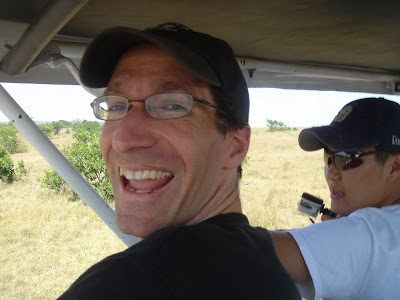
- Anand - An IU resident headed home to Baltimore & a hospitalist job. Anand was my resident on the medical wards and was very good at answering the question "so, what would we do in the states for ____?"

- Honorable mention, of course, to all the old friends whom we worked and came to know much better. They were, however, disqualified on a technicality.
Favorites in the IU House Family
- Dunia & Chelimo - Sisters, Dunia & Chelimo run the show at IU House. We were all very excited about plans to meet Dunia's family and share a hookah in a completely appropriate & legal cultural exchange... plans which were derailed by a ill-timed bout of gastroenteritis. Next time...
- Margaret - A warm and motherly housekeeper at IU House & hostess at church.
- Joseph Kimani et al. - One of the crew of guards on constant watch at IU House, Joseph or "Kim" was also a demanding training partner, preferring to finish runs first with a backwards run back up the hill & then a sprint to the bottom.

- Peninah & Julius - The mother & father of the IU House dining room, both in Peninah's choir, last seen singing & dancing on the back porch behind the kitchen.
- Naomi, Leah & Lucky - The younger generation in the family of Peninah & Julius, they
 were a nightly presence in the IU House dining & computer rooms, and the nighttime keymasters to the pantry.
- Benson, Simon & Kelvin - Unofficial social chairs for visiting students & residents.
- Gabriel* - To leave IU House, we pass through one gate & then another gate. Gabriel works six days a week at that other gate. All the hours without the IU House benefits. He always warmly received my Kiswahili greeting of the day, regardless of whether the sounds spoken made sense.
Favorite Foods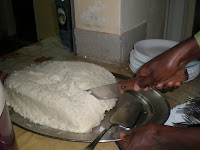
- Ugali - Delicious, starchy, and tricky to make, though its only ingredients are flour and water.
- Sukuma wiki - "Kales", translates to "push the week", suggesting that it fills those meals on days when shillings are especially tight.
- Chapati - If you are a fan of tortilla, naan, flatbread, pita bread... chapati is better than the all those stacked up.

- Samaki - I made substantial progress in my ability to eat the fish and not eat the bones. Philip sets the bar high. Practice, practice, practice.
- Orange Fanta - A ballpark estimate, I drank upwards of 30,000 mL of Fanta. I love the stuff and somehow will not drink a drop once back on US soil.

- White Cap Light (Kenyan light beer)
- Mango (in Peninah's nightly fruit salad)
Favorite Patients
- Annette - My first patient on the wards, who was carried into the Hospital and walked triumphantly out.

- Victor - An adorable child who suffered years of abuse, eventually landing in AMPATH's orphans and vulnerable children division. We started out with a handshake, but when he was discharged I received a big hug.

- Josephat - Truly a miracle, after 38 days in the ICU, smiling.

- Faith - Enduring a 6 week hospital stay with grace and a friendly greeting during rounds.

Most Challenging Illnesses (AKA Most Common Illnesses on MTRH Wards) - This category deserves and hopefully will receive far more reflection than it will get right here.
- Rheumatic Heart Disease
- AIDS
- Tuberculosis
Favorite Kenyan Medicine Terms
- Hotness of Body (fever)
- Awareness of Heartbeat (palpitations)
- Branula (IV)
- Sister (nurse)
Best Places in Eldoret
- Roads surrounding IU House feat. the River Path - I had some of the best runs ever, and Joe spotted famous marathoners such as Ezekiel Kemboi.


- Bench in front of the Student Hostel - Best place to socialize.
- Queen Chic - This restaurant has the best and biggest Ugali portions, plus fast service and chips masala.
Best Chorus in the "Barack Obama" Song
- The "Barack Obama" chorus
Obama!
Best Medical Student Hostel Dorm Room
- 1-25L - Philip & I conducted the majority of nearly thirty interviews in his dorm room. More than a full day's worth of me at the foot of the bed with my back to the wall, audiorecorder near my left knee, Fanta to my right, Philip overseeing the operation overall.

Best Salespeople in Eldoret
- Molo - One of the things Molo sells is metal clothes hangers. He occupies a choice location on the end of an especially industrial strip of market about a half mile from the medical wards, which are full of patients in desperate need of IV fluids but too often lacking IV stands. Molo quickly earned my business, that business being the task of turning clothes hangers into IV hangers. My interns quickly declared it the "best thing you've done".

- Monica - Enthusiastic market woman who gave free bananas and Swahili lessons

- Max - The gatekeeper to all things taxi for most of the IU House crowd... and yet another patient Kiswahili teacher.
Best Sightings on Safari

- Two lions under a bush six feet away

- Elephant baby
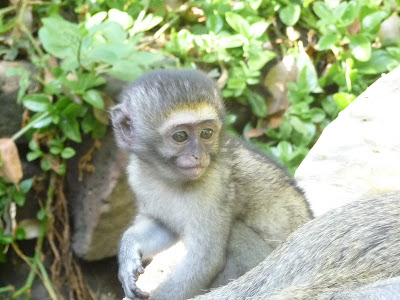
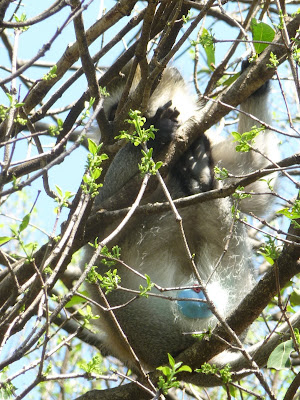
- Vervet monkey baby (Close runner-up in the Vervet Monkey category is the electric blue monkey scrotum)
- Birds on giraffe neck and buffalo nose. (Of note, those ears.)


Favorite Intern
- Juma - At one point working without a co-intern, Resident, or attending, Juma managed a team of 40 something very sick patients during his first month of internship. I cannot imagine doing that come July.
- Kairu, Pita, Omar, Blano - Fact is, all the interns claim the distinction of taking care of many, many sick patients with inadequate guidance or supervision, but plenty of gusto. This is an incredibly hard-working bunch.
Favorite Phrases Inexplicably Written on Matatus
(Please allow one more day in Nairobi for full data collection)
Favorite Kenyan Politician Traveling on our Flight to Nairobi
- William Ruto - The Kenyan Agriculture Minister
 has been in the news frequently in the past two months. There was a "Maize Scandal" which I was never fully able to figure out. A maize shipment had been lost, stolen or otherwise mishandled, and blame landed on Ruto. There was a censure motion in Parliament, watched and listened to by most Kenyans, it seemed. He made it out with his political life but may have had to agree to reinstate some other Minister recently kicked out over corruption. That's either a gross oversimplification or a rational explanation where there is none. More recently, he was tagged as the Minister most likely to have been the Kenyan Minister banned from the US permanently for his corruption. We knew something was amiss when a helicopter landed at the Eldoret airport. I stared as much as I could to confirm his was the mug so frequently on the front page of The Nation.
Favorite Riots in Nairobi in the Past Month - When all other forums for redressing injustices have proven themselves useless,
Cutest Pictures of Anne & Joe (AKA Frontrunners for the Save The Date Card) -
This category was designed with our mothers in mind.


Tunasafiri nyumbani,
Anne & Joe
The Masai Mara is "a large park reserve in south-western Kenya, which is effectively the northern continuation of the Serengeti National Park game reserve in Tanzania", so says Wikipedia. It is named for the Maasai people who have traditionally lived in the region & the Mara River... also in the region. It is a popular travel destination from all parts, especially from IU House in Eldoret.

I didn't make it to "The Mara" in 2007, so Anne & I had counted our shillings in anticipation of this finale weekend. It was spectacular. The views, both in the presence of the abundant wildlife and with that of the horizon alone, were uniformly breathtaking. We had a wonderful time, some of which was spent not viewing our surroundings through a 3-inch camera screen. A collection of more than 1,100 pictures from the group says otherwise.
We traveled with a group of six, all students fresh off matching at their residency of choice & myself, fresh off Anne matching at my residency of choice. Our travel agent, driver & guide Eric is on the left... with Jason, Molly, Rozi, Dave & Anne up top.

The Big Five includes lion, elephant, cape buffalo, leopard & rhinoceros... We saw so many of the first three that we were passing them by in search of newer sightings on our fourth and final game drive. A game drive consists of sitting or standing in the above pop-top mini-bus and looking out. Just looking and looking. I somehow came to believe that leopards were to be found in the trees. Even hours after leaving the park, I couldn't keep myself from eyeing the contours of individual branches of trees, searching for a dangling tail or spotted fur. The elephant in the foreground is right-tusked, as he or she has worn the right tusk down with use.


I am still completely fascinated by giraffe. They have only seven cervical vertebrae like you and me... as well as a long, black tongue.

Our two guides were a mysterious duo for most of the weekend, stopping, looking through binoculars and talking rapidly in Swahili, never really filling us in on their safari guide ways. On one occasion, someone picked up the word "simba" as we rolled in amongst some bushes. As the van passed within three feet of the male lion in the twosome, he stood up and took a few steps away. We gasped & lunged toward the far side of the van, only to creep back to the glass and stare, stare, stare. We were close enough to see the bugs crawling on the female's belly. We speculated that those same bugs were the cause of the male's disinterest in her affection.


 There are several hundred more where those came from and time in the coming days to sort through them all, posting only the finest, of course. Hyena, hippos, wildebeest, hartebeest, topi, two species of gazelle, zebra, baboon, vervet monkey, warthog, mongoose, a cerval cat and various birds, the largest shown below.

The game drives either began with a sunrise or ended with a sunset. I have plenty to get done before we leave Eldoret tomorrow afternoon, and I have just now sat for at least fifteen minutes, completely incapable of making the difficult decision of which picture of the sun rising or setting over the Masai Mara to choose.


We now have one day in Eldoret, one day in Nairobi, one day in the air and another day in Providence before getting back to work at the Miriam. I expect we'll continue to reflect on the past two months in the days & weeks ahead... mixing in the more mundane tasks of buying a home in Providence and a dog to put in it. We are sad to leave but excited to get home.
Usiku njema,
Joe

Match day started out at the wards for me, and with a good omen. I was chosen to do my first ever morning report (case presentation + lecture) with Sarah, one of the Brown chief residents.

Later, during rounds, Josephat, a patient who has been in MTRH for the duration of our time in Eldoret, was discharged. He came in with tetanus, something we don't see in the states because of childhood vaccinations, and access to emergency care. He had nearly total-body muscle spasms, was intolerant of light and noise, and ended up iatrogenically paralyzed and sedated in the ICU for 38 days. He is now walking, and had a really big smile for me.

So, Match Day was wonderful, and this announcement is slightly delayed because after we found I am headed to Brown, we left for safari on the Masai Mara to celebrate, pictures and details will follow.

We had our own celebration here in Eldoret, thanks to wonderful IU and OSU residents. We surrendered our names and passwords to them, and they created tongue depressor envelopes and picked them at random, just like the real deal. I was the last person chosen! But the news was worth the wait.

Umeshindaje leo? Translates, I believe, to "How have you won your day today?" The reply to this question, just as it is the response to that of "How are you feeling today?" put to a clearly badly-feeling Kenyan patient... is "Nzuri" or good.
This past week, my final week was the first in the Internal Medicine rotation for a new group of students, still very early into their first clinical year. I found myself excited for the opportunity, the hope, the off-chance of playing a role in laying down the fundamentals... Med Student 101. To say just a few words, set a few examples on those first days on the wards before other examples are available.
At the end of the week, mixed results. I really enjoyed the time spent with this group of students, nonetheless. Ah, the SOAP note. Perhaps an American convention... but a really useful one. (For those of us unfamiliar to wards medicine, SOAP is a format for writing notes in a patient's medical chart... One that should help in thinking (hopefully in a critical and organized way), but thinking at all is the key). Anne apparently had a much higher success rate in getting SOAP notes from her students than I did, but I did have one or two successes.
Our friend Barb, a resident from Utah, pulled off an elaborate contest amongst her medical students on her final day. It involved scoring for content and presentation and required a level of organization of rounds that I can still not fathom. My successes were more modest.
A fourth year student named Lawrence presented a 40-year-old woman, status post two failed courses of treatment of pulmonary TB with a recent tissue diagnosis of an intrathoracic chest wall sarcoma. Bizarro... But we had a really nice discussion of the issues at hand. He was given all of 30 seconds to present before the team summed things up for him and moved on. A sixth year student named Cynthia was given even less time to describe her plan for a uncontrolled diabetic with a foot wound. Ambrose, another fourth year, however, did get credit for diagnosing and fixing a patient's kidney failure... and was all over the patient's medication regimen, thanks to our work together.
Prerounding, which is the fine art of the medical student evaluating a patient on his or her own each morning day after day, is a new and fragile experiment in one corner of the wards, started last month by an Attending physician named Deb Litzelman from IU. It has met with resistance in some ways from the students. It has, so far, bent but not broken. I doubt that this short week will make the difference in whether the "pilot" project lives or dies. I do think that Ambrose now knows the joy of a creatinine, once deranged, again within normal limits.
More recently, Anne, Philip & I orchestrated a feast at the IU House last night. Kenyan students who will shortly be traveling to IU, Brown & Utah joined a few American students & residents for dinner... and did every bit of the work in preparing a huge traditional Kenyan meal. For the price of (delicious) sushi in our beloved Cranston, RI, we fed 25 hungry people. Philip was responsible for talking down the women in the market from the "wazungu" price... to something slightly more reasonable. At one point, we agreed that he would be more likely to get a decent price on peas if we weren't nearby. We separated. The peas were still expensive. Either the demand for peas is way up, or word travels fast when wazungu are in the market. Pictures to come shortly...
Joe
We spent the first part of this week in the westernmost part of Kenya, working with one physician (Dr. Dennis featured below) and several clinical officers.

We've spoken to the magnitude of the AIDS pandemic, and to the impressiveness of the AMPATH response, and I think the patient stories we heard on this trip really exemplified both. [Below is one of the clinics, two shipping containers side by side with a thatched roof - the quickest, easiest, and cheapest model found so far]

AMPATH is the academic model providing access to healthcare, and was started by a group including Dr. Joe Mamlin (who I also learned is responsible for the Wishard community health centers in Indianapolis) in 1990. Dr. Mamlin describes the first clinic sort of operating out of one room when AIDS was still relatively unheard of. Now AMPATH (recently a part of USAID) has blossomed to a network of 19 clinics in Western Kenya, providing free anti-retrovirals (ARVs, a common regimen below), prophylaxis against opportunistic infection, food, counseling, and medical care to upwards of 80,000 patients.

AMPATH also has several programs in place to help patients establish food security, financial progress, and occupational skills. There is also a network of homes for orphans and vulnerable children. All of this to say that even with this longstanding infrastructure in place, HIV is still rampant, the stigma of being positive remains devastating, and people with families (big families!) are dying every day.

Many of the women we saw on Tuesday were widowed, their husband never being tested or seeking treatment for AIDS. AMPATH clients are overwhelmingly female, and I asked the clinical officer (non-physician, three year diploma, can see patients and prescribe drugs) why this was. He explained that many men in Kenya see illness as a threat to manhood and suffering admirable, and so eventually die at home, never being diagnosed with AIDS, and therefore never disclosing this diagnosis with their sexual partners. (VCT stands for voluntary counseling and testing)

I met one woman, who tested positive pre-natally. Within a year, her husband had died, and she gave birth to her sixth child. Luckily, she was placed on ARVs, and did not transmit the virus to her newest born, the other five children have yet to be tested. We examined the baby, and then addressed the more complicated issue of depression. What will this woman do with no income, six children, and fragile health? All day women with the same story came through the clinic. (This is a scene right outside the clinic in Busia)

Another common theme was the use of protection. All the women, widowed or not, were advised to use protection if their partners' status was unknown. Often they would be shy when addressing the topic, but would eventually admit that their husband wouldn't or "couldn't" use a condom. One woman explained to us that since she had been found HIV positive, her husband married again, and is no longer having intercourse with her. Neither the husband, nor the second wife have been tested.

On the trip, I was reminded of just how rural Kenya really is. Over 90% of Kenyans live in rural areas (below a scene outside the Busia clinic), and that means without water, electricity, or much access to education and healthcare. We had a patient in the hospital today, and the history of present illness was something like this: while the mother was milking a cow, her toddler fell into a well, and drowned for around 10 minutes before he was found. This particular child was doing really well this morning, all things considering.

All of this to say, I find the complexities of the AIDS pandemic overwhelming. AMPATH is pouring millions of dollars worth of resources and brain power into slowing the spread of the disease. I asked Dr. Mamlin if anyone else in sub-Saharan Africa was doing anything like AMPATH, and he responded that there was maybe a program in Gambia, but not really. I can't imagine the devastation in a place without such aggressive testing and treatment. (Between the clinic and the food storage facility)

Further, there are other preventable illnesses killing plenty of Kenyans daily, diarrhea, malnutrition (we consulted the nutritionist on over half of my pediatric patients because they were severely underweight), rheumatic heart disease, and the list goes on. Despite the daunting statistics, I find encouragement in the future of Kenyan medicine. So many of the students I have worked with are really, really good, and their country needs them. I look forward to their eventual takeover of AMPATH or organizations like it. For now, I'll finish philosophizing and say goodnight (one of my favorite, or at least most comfortable phrases in Kiswahili), Lala Salama.
 We returned this evening from two days spent in the westernmost parts of Kenya near the Ugandan border and the shores of Lake Victoria. HIV prevalence near the lake is much higher than in most other areas in Kenya, and AMPATH's focus in the area reflects this fact. After Tuesday morning clinic (more to come from Anne, I hope), Dennis recommended a quick diversion to lay eyes on the lake.
He shared his insights into the relationship between the lake & the spread of HIV. Two stand out. Fishermen work hard, staying out several days at a time, and get paid relatively well, especially for an area as diffusely poverty-stricken as any one of many lakeside villages. Young men with money & little else to do often choose to involve themselves in alcohol and sex... hence HIV spreads. And two, the fishermen fish, leaving the wholesaling of their catch to middle men just yards away, at least in Port Victoria. It is no doubt a competitive market (see a sample of Nile Perch on the bidding table below). In cases where the middle men are women, it was suggested that sex may become piece of the transaction. Dire straits to be sure.
Interesting or not, for me these anecdotes highlight the complexity of this pandemic. Antiretroviral medications do a really good job of treating a virus. Poverty & stigma are different and far more daunting beasts to confront. AMPATH, nonetheless, is making remarkable headway.

 Tulikula samaki kwa ugali halafu tulishiba,
Joe
Another weekend spent taking in the sights and sounds of Eldoret is winding down. A slow Saturday followed a night of dancing. Philip & I completed several more interviews and are drawing ever closer to the end of our schedule of interviews. (I neglected further updates since my earlier concerns about approval for our study. To fast-forward, though it didn't feel like it at the time, we have been making progress and do expect to complete Part One of the study in time to make our flight out of Nairobi. Further details to be found in written and hopefully published form... likely many, many months from now)
From there, I joined Anne in the dorm room of her friend, Lillian, whom she was taking up on an offer to teach ugali-making. Ugali is a staple of the Kenyan diet for several reasons, I'm sure, the most important being that Kenyans seem to really love it. We delved into Lillian's own ugali-making education, ugali preferences and pointers... and finally enjoyed a really good dinner. Dan, forgive me for having forgotten the name of the Tongan version of ugali, and please comment and answer me that question.

Sunday morning, we got up for the 10:00 mass at the Cathedral (pictured below with Margaret, who works at IU house, and two of her children) in Eldoret.

We were in a packed church, alive with music and praise. The whole of the service was in Kiswahili, and fast, so we were unable to understand much of what transpired. Luckily, mass format doesn't change much, so I was able to gather, then pass on to Joe, what people were likely singing and saying. The choir, on their third consecutive mass, was wonderful (listen to a few songs below). From what we could tell, there was an emphasis on addressing the food shortage in Kenya, so grocery/market bags were placed up at the altar during the offering, and there was a special collection for the food bank. I think that one of my favorite things about being Catholic is that we are everywhere, and often doing good work.
In the afternoon, we left town for a hike with Philip & Robina at Mlango Falls.

 Always the gentleman... That's Philip helping Robina while carrying Anne's bag and the blanket that I insisted on bringing.

 We followed a well-worn path downward following the course of the waterfall. The path quickly ended, and the four of us scrambled over a few more large boulders and had a seat. Nothing overly strenuous, Anne managing quite ably in the flip-flops I might have warned her against wearing. Moments later, literally from above where we were sitting, a young boy emerged, smiling widely in a what appeared to be a combination of the joy of climbing on rocks and the pride of being admired for doing so with such ease. To look at these kids, it is immediately clear that they spend serious time climbing around in this waterfall. The skin on their knees and shins is thick & scaly from hours of rubbing against and sliding over rock. They moved as comfortably on narrow ledges and wet, smooth rock as I once did on the flat, green grass in my backyard in Carmel, IN.
 The crevice he first climbed down looked like something that I could manage. Only after barely managing it did it dawn on me that his ability to climb to or from a particular perch did not correlate well with my safety there.
 There was no place amongst this massive assembly of boulders in the waterfall that the most daring of the group (on the left above) couldn't get to with ease. With only minimal exaggeration, he walked up a 30-foot vertical rock face with nothing but bare feet. Eat your heart out, Climb Time. The little baby down-climb you see me in below was legitimately frightening. He can be seen smiling down from above.

As we were climbing up out of the rocks, I dropped a waterbottle into the water. Lightning fast, he's out of sight... until a tiny hand snatches the bottle just as before going over and out of sight with the current. He and his friends were rewarded with all the snacks we had with us.
Last but not least, in an effort to keep some focus on our main purpose, though one of many, in traveling to Eldoret, a picture of Anne hard at work "clerking" a pediatric patient.
 Tomorrow, we head west to the towns of Kisumu, Busia & Port Victoria for the early part of the week. We will be shadowing a Kenyan physician and soon-to-be Brown intern named Dennis. Hopefully, we will be able to repay his hospitality when he leaves his home & family to move to Providence and internship in June. Chas, sadly, Port Victoria will be the closest we get to Mfangano Island for now.
Excited to get home to see the Hoosiers in the post-season,
Joe & Anne


