2.10.09—
After a brief vacation we are back on the wards. Each day has provided much fodder for discussion, and lessons on how things work (or don’t) in Moi Teaching and Research Hospital (MTRH).
I’ll share a couple of stories. Today was the first out of my four so far in which we didn’t encounter a deceased patient during rounds. In discussing the patient in the next bed, or in one case, the same bed, our astute intern had broken off from the group, taken the pulse, and looked in the eyes to pronounce death. The HIV rate in Eldoret is around 7%, but on woman’s ward at MTRH it is much higher.
The constraints under which Kenyan physicians work are pretty remarkable. Joe noticed a patient seizing as we were walking through the ward yesterday. Upon speaking to the pharmacist, we found that there is a nation-wide backorder on benzodiazapines (the first line treatment for status epilepticus). Not only that, but the less desirable seizure medication that was settled upon, wasn’t able to be give at a high enough, or therapeutic dose, because the hospital doesn’t have the staff to adequately monitor.
Worse, today we had a patient admitted two days prior with a very low CD4 count (monitor of white blood cells in HIV, low=bad), severe shortness of breath, and hypoxic overnight. We ordered a stat chest x-ray, only to find out that in the entire hospital (Eldoret’s tertiary care center, Eldoret being the 4th largest city in Kenya), chest x-rays weren’t being done, probably because of a shortage in blank film sheets. Further, they are out of the reagent used in the initial test for HIV.
I had to present in rounds for a Kenyan attending today, who happened to be the hospital chief of medicine. He is a tall, stoic presence with a booming voice and stern face. He was quick to reprimand, and call attention to the students’ errors. We often hear complaints that Kenyan medical students speak very softly, especially during rounds. However, today, as I was presenting my patient, he kept saying in this annoyed voice, “Am I hard of hearing? Can anyone else hear her? Speak up!” So maybe it’s not just the Kenyans…
We’ve been trying to run in the morning. We were reminded by our favorite running store owner/tri-athlete the Eldoret is the distance runner training capital of the world. The altitude has kept us to less than marathon jaunts, but it is really beautiful here in the morning, somewhere near sixty degrees, the sun just dawning. We see lots of kids, uniformed, walking to school, other runners, and are able to greet people in some of the little Kiswahili we are comfortable with. “Habari ya asubuhi?” Good morning, or how are you this morning.
For now, lala salama, or good night.
- Anne
Wednesday, February 11, 2009


Sunday, February 8, 2009
2.7.09--What's the Sound of One Hippo Snoring
Anne & I finished last week with two days on the wards at MTRH. We'll hopefully be settling into a routine starting tomorrow morning. Over the next few weeks, I hope to think far more about people than animals. Nonetheless, this weekend was an animal-centric affair.
We left Eldoret on Friday afternoon for a weekend vacation in and around Lake Naivasha and Hell’s Gate National Park. We stayed in a little hut, or "banda", Anne & I sharing a narrow twin bed with an ill-fitting mosquito net. Below, the view of your porch at first light and the one from our porch a few minutes later with Lake Naivasha in the background..


The trip included some biking, hiking, eating, drinking and ogling wildlife. My personal highlights were giraffe, monkeys & hippos in that order. There were zebras ("punda milia"), warthogs ("pumba"), gazelle, impala ("swala"), elan and various big birds.


To be more specific, the sight & sound of giraffes running was absolutely fascinating. The giraffe were weary to let us get too close, eventually galloping off into cover of nearby trees. They seemed as mystified by the looks of us as we were by them, just enough to let us creep within a good staring distance. “Twiga” is giraffe in Kiswahili.


As for monkeys, the smaller the better… Giraffe just don't look like they were made to run. Monkeys, on the other hand, were clearly designed to chase each other through trees. We saw vervet monkeys, black-and-white colobus monkeys and yellow baboons. Below are the vervet monkeys roaming our camp and the yellow baboons flagging down passing motorists on the highway to beg for scraps...


Now hippos… a fearsome beast per report. Apparently, hippos kill more humans each year than you’d think. Any sound coming from a hippo is therefore a little unnerving. At 4 AM, we were awoken by a deep baritone barreling into our little hut. Hippos mating, fighting or in some kind of pain were all guesses made. I think he was snoring.
(Link to be added once our Tech Dept. can figure it out)
On the boat ride back on Lake Naivasha, our tour guides arranged a small show. He first quite violently stuffed a fruit of some kind down the gullet of a small fish to make it float, then let out a loud, shrill whistle and heaved the fish into the water. Clearly very familiar with the drill, a fish eagle takes flight from the tops of the trees on shore and swoops through to snatch up the fish. Staged, but still quite nice. Tilt your head appropriately to enjoy the visual aid.
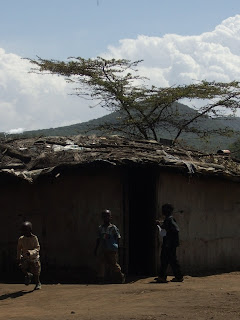
We were accompanied on our first day's hike by a boy named Mohamed. He was 11 years-old, a Maasai, spoke excellent English and was a real pleasure to have along. Mohamed encouraged the group to visit his nearby village. A man who appeared to be the village spokesperson assured us that the small entrance fee was to be put toward the children’s education. If Mohamed is an example of how well the kids are being schooled, then it was a few hundred shillings well-spent. There was some question as to the authenticity of the display we were shown as at least one of the Maasai men had on a collar shirt and dress shoes on under his traditional garb. There could be no doubt, however, as to the genuine cow dung used to build the huts in which these people lived. A strange juxtaposition to be sure. Below is Mohamed with his home in the background. We were given a tour of one of the homes as you'll see...


Signed,
Joe
We left Eldoret on Friday afternoon for a weekend vacation in and around Lake Naivasha and Hell’s Gate National Park. We stayed in a little hut, or "banda", Anne & I sharing a narrow twin bed with an ill-fitting mosquito net. Below, the view of your porch at first light and the one from our porch a few minutes later with Lake Naivasha in the background..


The trip included some biking, hiking, eating, drinking and ogling wildlife. My personal highlights were giraffe, monkeys & hippos in that order. There were zebras ("punda milia"), warthogs ("pumba"), gazelle, impala ("swala"), elan and various big birds.


To be more specific, the sight & sound of giraffes running was absolutely fascinating. The giraffe were weary to let us get too close, eventually galloping off into cover of nearby trees. They seemed as mystified by the looks of us as we were by them, just enough to let us creep within a good staring distance. “Twiga” is giraffe in Kiswahili.


As for monkeys, the smaller the better… Giraffe just don't look like they were made to run. Monkeys, on the other hand, were clearly designed to chase each other through trees. We saw vervet monkeys, black-and-white colobus monkeys and yellow baboons. Below are the vervet monkeys roaming our camp and the yellow baboons flagging down passing motorists on the highway to beg for scraps...


Now hippos… a fearsome beast per report. Apparently, hippos kill more humans each year than you’d think. Any sound coming from a hippo is therefore a little unnerving. At 4 AM, we were awoken by a deep baritone barreling into our little hut. Hippos mating, fighting or in some kind of pain were all guesses made. I think he was snoring.
(Link to be added once our Tech Dept. can figure it out)
On the boat ride back on Lake Naivasha, our tour guides arranged a small show. He first quite violently stuffed a fruit of some kind down the gullet of a small fish to make it float, then let out a loud, shrill whistle and heaved the fish into the water. Clearly very familiar with the drill, a fish eagle takes flight from the tops of the trees on shore and swoops through to snatch up the fish. Staged, but still quite nice. Tilt your head appropriately to enjoy the visual aid.
We were accompanied on our first day's hike by a boy named Mohamed. He was 11 years-old, a Maasai, spoke excellent English and was a real pleasure to have along. Mohamed encouraged the group to visit his nearby village. A man who appeared to be the village spokesperson assured us that the small entrance fee was to be put toward the children’s education. If Mohamed is an example of how well the kids are being schooled, then it was a few hundred shillings well-spent. There was some question as to the authenticity of the display we were shown as at least one of the Maasai men had on a collar shirt and dress shoes on under his traditional garb. There could be no doubt, however, as to the genuine cow dung used to build the huts in which these people lived. A strange juxtaposition to be sure. Below is Mohamed with his home in the background. We were given a tour of one of the homes as you'll see...


Signed,
Joe
Thursday, February 5, 2009
2.5.09 - Woman on the hospital floor
 Today was my first day on the wards. I was just shadowing another American medical student, but quickly became overwhelmed. I think no amount of preparation or "third world experience" could've prepared me for the smell of disease permeating the hospital. I feel guilty for being able to walk in and walk out, to make jokes, to eat warm food when there is epic suffering going on. But I quite easily do those things, here and in the states. There was a woman with pellagra, niacin deficiency, that we learned about sort of in passing, but that none of the American students and residents have ever seen because all of our food has been fortified. There was a man likely breathing his last breaths in a crowded room with no family around. I saw him, only to be shown what a patient's breathing looks like when they are eminently dying (a teaching point I think is useful, but awful at the same time). Joe had told me that many patients have to share beds, but to see two women wasting away in a small twin bed was horrifying.
We met up with the Kenyan student friend of Joe's and co-investigator today. He was wonderful to get to know, showed us his room in the student hostel, and took us out for a coke in downtown Eldoret. He describes being a medical student as a privilege, but acknowledges that many students often forget this fact. I told him it was the same scenario in the U.S. He also gave Joe his only hat, as the mid-day sun on the equator proved a scalp-burning force.
We had dinner with an economics professor from Columbia. He seemed to think that the stimulus package and caps on executive pay were okay, with no net positive or negative. I wished I had any knowledge on the matter.
www.daylife.com/
- Anne
2.5.09--IU House in the morning
One last day of traveling yesterday started at an exceedingly nice hotel called the Country Lodge in Nairobi. We were told the hotel was on the safest street in all of Nairobi by our driver from the airport... As he nods his head to the high, heavily-fortified wall to our right, "Israeli Embassy, " he says.

At Jomo Kenyatta International Airport, we were able to retrieve our luggage at the sixth desk/office/checkpoint to which we were sent… most importantly, of course, it was retrieved. Outside the ticket office at the airport below. I have always found it challenging to find a balance between taking thoughtful pictures that might convey some sense of place and being intrusive and overly tourist-y. The gentleman in the picture below may have made up his mind on the question.

One final wait for boarding...

And a short, 45-minute flight in a small prop plane...

Bring us to Eldoret.

We were given a brief introduction to a story which Anne & I kept a close eye on for several weeks more than a year ago, promptly forgot but now hope to put in some context. For a quick summary and an interesting post-script, follow the link to a recent New York Times article describing the election and America's role in its aftermath. Anyhow, as we drove into Eldoret Town from the airport, our driver asked if I had been in Eldoret "before the clashes". He described them as "terrible" with "fighting in the streets". To our left were the burnt-out remains of homes along one stretch of the road, to our right was a long dusty strip leading to a still-populated camp for those displaced during the violence. One year later, our driver reports that some 3,000 people still call the camp home for lack of anywhere else to go or due to lingering safety concerns.
On a separate drive, yet another driver named Tony told us that his mother was Maasai, his father Kikuyu. He had married a woman from yet another tribe. He described marriages between tribes as quite common. There was an undertone of pride and perhaps allegiance to his Kikuyu roots, today the largest and historically the most successful &/or powerful of Kenya's many tribes. I imagine we'll find that tribal tensions have not greatly changed since last year but there does not appear to have been any further violence for many months. The fine line between the bloody tribal conflicts of a year ago and the for-the-most-part peaceful, very normal-appearing happenings of a multi-ethnic society is one that I stuggle with and don't understand. Growing up male, white, suburban and Midwestern didn't provide me with the experiences with which to relate. In this case, mark that in the "plus" column of the above four adjectives.
Lastly, one unanimously positive piece of Kenyan news comes not out of Kenya but from the U.S. Kenyans appear to agree when it comes to Barack Obama. Our driver Tony told us he knew Senator Obama was destined for great things. Even described betting what sounded like a huge sum of money on it. President Obama's grandmother's experience at his Inauguration has been front page stuff since we arrived. See Mama Sarah below.

Today, Anne & I head into the hospital for the first time. "Unasikiaje leo?" means "How are you feeling today?" We shall see.
Joe
Wednesday, February 4, 2009
2.4.09--Kwanza
 Jambo! Habari za asubuhi. I hope to be able to share more Kiswahili, but today, Hello! and Good Morning and numbers 1-10 are the sole product of our breakfast lesson.
We look forward to being in Eldoret this evening, after some epic traveling. Shortly after takeoff on our first flight, 8ish hours from Chicago to Amsterdam, the flight attendant made sort of a frantic plea on the loudspeaker asking for the help of any doctors on the plane. Joe valiantly responded to the call, and I played a consulting role, glad to still be a student for a couple more months. The concern was that of a younger woman with leg and later chest pain in the midst of returning to Holland from Fiji, putting her at risk for something as serious as a pulmonary embolism, or potentially a panic type reaction. We went through some scenarios in which Dr. Frank might make the decision to land the plane in Iceland or Nova Scotia, but the woman made it safely, and called Joe “the kindest doctor she had ever met.”
As for “Lucy,” (see earlier post) as a world history teacher (in NYC my first year after college), I remember my class of mostly Dominican and Puerto Rican students being floored by the idea that the first humans originated in Africa. In fact, many did not believe it, and because I didn’t do an adequate job of explaining the evolution of skin color, several refused the idea entirely.
The question that resonates with me is, how can the continent in which civilization began, be so far behind the rest of the world? Often, I use the general concept of colonialism to explain the woes of Africa. A recent book by Paul Collier, The Bottom Billion asserts otherwise (more on this book later). I think the fallacy I typically commit is to take the bits of history that I am familiar with (i.e. colonialism), and use only them to explain characteristics of place. A goal I have for this trip will be to ask more questions, to broaden my knowledge of the Kenyan story, and to maybe forgo simpler explanations for the more difficult, inexplicable, or undesired.
Lastly, at dinner last, I tried a Kenyan bia (maybe my favorite word yet) called Tusker, which was delicious.
Anne
2.4.09--Arriving in the Cradle

The Great Rift Valley is a name given in the late 19th century by British explorer John Walter Gregory to the continuous geographic trough, approximately 6,000 kilometres (3,700 mi) in length, that runs from northern Syria in Southwest Asia to central Mozambique in East Africa. In eastern Africa the valley divides into two, the Western Rift Valley and the Eastern Rift Valley. Eldoret sits atop the high plain between the two, as does Lake Victoria, the second largest area freshwater lake in the world, to the west.
Because the rapidly eroding highlands have filled the valley with sediments, a favorable environment for the preservation of remains has been created. The bones of several hominid ancestors of modern humans have been found there, including those of "Lucy", a nearly complete australopithecine skeleton, which was discovered on November 24, 1974 near Hadar in Ethiopia by anthropologist Donald Johanson.
Named Australopithecus afarensis, "Lucy" is an extinct hominid which lived between 3.9 and 2.9 million years ago. Recent analysis in 2006 calls into question her place as our ancestor, yours and mine. Nonetheless, I will be liberal with the use of the idea of a "Cradle of Humanity". I find it a fascinating context in which to view the events in this part of the world, somehow casting tragic events in an even more tragic light. The same applies to the state of affairs in Iraq, once Mesopotamia and commonly considered the "Cradle of Civilization".
Which brings us to the first installment of what I hope will be a regular piece... call it Current Events Kenya. We will strive to include any "feel-good" stories that make news in Kenya. This is not one of those stories.
As for Current Events Anne & Joe, we arrived safely if not by the expected route. Apparently, London was closed yesterday. We were able to get re-routed through Amsterdam, but had to jog it up through both Chicago and Amsterdam airports to make connections. Our bags didn't have that same sense of urgency. There was a first for me on our flight to Amsterdam, an early start to doctoring in a resource-poor setting. I'll let Anne tell the story. Our last leg takes us on to Eldoret today.
And because it's going on midnight EST, we'll say good night... or lala salama in Kiswahili,
Joe
Monday, February 2, 2009
2.2.09--Leaving the Heartland
 A lovely weekend was spent in St. Louis, MO celebrating the marriage of Matt & Katie Helbig (Anne's best friend and college roommate) and enjoying the handiwork of some very industrious hippies at the City Museum, we headed home for a Going-Away/Engagement Celebration dinner at the Gabonays. Now at the airport, it's official. Though our travels may have technically started in Providence, RI several days ago, leaving Indianapolis still feels like leaving home.
We'll stop in Chicago, Heathrow (closed for snow?), Nairobi for one night and then on to Eldoret. Located in western Kenya and the western rim of the Rift Valley, Eldoret is the home of the IU-Kenya Program, Moi Teaching & Referral Hospital and our homebase for the next eight weeks.
http://en.wikipedia.org/wiki/Eldoret
Subscribe to:
Posts (Atom)

