Monday, February 23, 2009

Nandi Hills

Kenya continues to have beautiful landscapes everywhere we've been.


Sunday I had the privilege to go with some of the medical and nursing students to a medical camp in Nandi Hills. An elder at the local 7th Day Adventist church described the area as having been inhabited by the Nandi peoples, who were fierce warriors and hunters. This lush area at the edge of the Rift Valley is now occupied by the Kalenjin, and covered in vast, green tea plantations.


The medical camp was extraordinarily well organized. There was health education given by public health students on hygeine, clean water sources, nutrition, etc.


Kids were de-wormed, then taught about teeth-brushing and keeping sugarcane consumption to a minimum (we saw several children with mouths full of caries).


People seemed to come from decent distances, all walking, to be seen by physicians, and prescribed free medicine.


Then later, after being cured of whatever ill, people stayed to socialize.


And the children played.


There was a sizable pharmacy, with most of the basics covered.


Many women came, children in tow, always asking for their children's problems to be heard first, then addressing their own health. I met a woman who was 22, with 6 children already. She spoke to the male medical officer, then pulled me aside and asked about contraception. She said she had been getting family planning shots (or Depo Provera) without telling her husband because he would be against the idea. Unfortunately, she had uncertain dating of the shots, and was likely pregnant again.


All in all, it was a wonderful trip, and great to get to know some of the students a little better. Here's the group mug.


- Anne

Tuesday, February 17, 2009

Umoja wards

Nearing the end of our second week here in Eldoret, we are both just beginning to get a sense for how things work in the hospital and how we might help them to work a little better or slightly faster. For every post describing a terribly sick patient or a tragic outcome, I will attempt to take a view from a more positive point. There is indeed a concentration of very sick patients on the inpatient wards. More importantly, at least in this post, there are some very smart residents, green-but-hardworking interns, eager medical students, veteran nurses, loving families and exceedingly tough patients.

Rounds begin roughly at 9AM each morning. With 3 "cubes" per ward, 8 beds per cube & approximately 1.5 patients per bed, rounds can push 1-1:30 on a long day. I have been fortunate to work with a very talented "registrar" or resident. She functions as the Attending most days, and does so better than the actual Attending... she is pictured teaching the chest pain differential and reviewing a CXR below.


I spent some quality time of Monday teaching the 4th year students the Frank method for interpreting chest X-rays... completely made up on the fly. It went very well. The CXRs that we're learning from aren't subtle.


You can see three cubes on each side of this hallway, making up the men's "Umoja" ward. Umoja means Unity in Swahili. The other wards tend to be named for various other ideals. At 1PM precisely each day, families of patient's flood into this and every other ward. Many sit with their loved ones throughout the day, picking up where the nursing staff leaves off. The food served by the hospital is a single thick piece of bread and a mugful of a thin, brownish-grey liquid. Many families bring food to supplement this very basic diet.


Looking out the back door of the ward to an open area where the more mobile of the patients tend to congregate. Fresh air is pan-cultural.


Decisions each day, critical clinical decisions are made based on all the data that is available... and can be afforded by the patient. Before ordering any of the more moderately priced studies, a member of the team discusses the recommendation with the patient. A quite literal cost-benefit analysis. More commonly, we round the following day to find that a head CT, for instance, was not done because the patient could not afford it. Hopefully, a family member is home working on collecting the money.

A bill sits in the flimsy pink folder that is each patient's chart... right alongside H&Ps, daily notes and lab slips. Many patients spend extra days on the wards after they are discharged because they are unable to settle up with the cashier on the wards. This is good and bad. There are certainly risks to the combination of immunosuppression and a coughing neighbor(s) with pulmonary tuberculosis. For instance, one patient had what appeared to be his first psychotic break on day four or so after treatment of anemia. This would fall into the "Good" category had his discharge plan not been entirely inappropriate. Tomorrow, though, I hope to pull of a biopsy in a patient discharged days ago with a plan for this same biopsy as an outpatient... which would be good. Below, the sign at the security post at the exit to the medical wards, staffed daily by two or three soldierly men.


Finally, back to Current Events Kenya, the front page of the paper today alleges a link between corruption and famine. Seems plausible.

We will be learning profound statements in Kiswahili during our eighth lesson. Until then, nitaamka kesho asubuhi halafu nitaenda kwa hospitali na kuona wagonjwa.

Joe

Sunday, February 15, 2009

Joseph Technicolor or Joseph the Dictator

We continue to have beautiful weather and wonderful weekends here. Friday we went to dinner with several of the Moi Medical students Joe had become friends with on his prior visit to Eldoret. We did a lot of laughing, and loved the description of Kenyan marriage rituals. According to our friends, the practice of the groom paying a dowry, is very prevalent, the more educated the woman, the higher the price, up to a million Kenyan shillings in some tribes ($13,000)! Joe was chastised for the amount of fish parts (bones, meat, facial parts) he left on his plate.


Saturday we took off to Kerio View, a restaurant and inn near to Eldoret with spectacular panoramic views of the Rift Valley. We hiked down from the viewpoint towards the valley, weaving through small farms, and encountering plenty of friendly children. One such meeting involved kids sledding on scrap plastic down a hill. One kid (repeatedly!) crashed directly into some brush.


The children were also amused by our whiteness, and some took a liking to Joe's name, calling him either Joe the Dictator or Joseph Technicolor. Sometimes they would walk with us, repeating English phrases like "How are you?" or smiling and saying "Wazungu!" (foreigner).


In the picture below, the sledding boys had started alternating between rapping for us and speaking in frog voices.

Our guide, Koech, standing in the background, seemed to know many of the people on the walk. He also did what was a pretty burly downhill portion of the hike in flimsy sandals more aptly than Joe or I.

The hike took us past his home, and he pointed out his sheep and cows.


Kerio View is also known as a wonderful place for paragliding. These kids had created their own small versions of plastic bags and twigs that worked really well!


We had a delicious dinner, and even had Kenyan tea and dessert. The food here has been really good. Tea and coffee are of the most flavorful I've ever tasted. (And the milk is in triangle cartons!) We've had a plethora of fresh fruit, including mangos, papayas, bananas, and oranges. We woke up Sunday for the Sunrise over the Rift Valley, and it was spectacular.


You can see Mt. Kenya in the background here.


And just a couple more closer to sunset (we're moving backwards in time).


Lala Salama. Tutafanya kazi kesho asabuhi.

One Hippo Snoring

The IT department has finally gotten its act together. We expect all were anxiously awaiting the arrival of this bit of audio. Self-explanatory.

-Joe

Evaluating ASANTE

Anne so eloquently recapped a lovely weekend... And so briefly, the first installment of a topic that I really hope will have many future installments. Months ago while wandering around Boston, Anne & I first tackled the subject of a research project here in Eldoret. Fewer months ago, my friend Philip Owiti & I kicked off an email correspondence regarding the same. I first met Philip on one of my very first days on the wards here in Eldoret two years ago, and then again when he did an overseas rotation of his own at Brown last spring.

Shortly before leaving Providence, we received the go-ahead from the IRB at Brown to begin a study interviewing Kenyan medical students, asking them to reflect on their experiences with visiting American students and physicians & soliciting suggestions for improvements to the IU-Kenya Partnership... today also known as the ASANTE Consortium. Philip had done a great deal of heavy lifting to keep things moving over here in the meantime. The IREC (the IRB on the Kenyan side) has yet to give us the green light... and realistically, may prove to be an obstacle we just can't get around. Nonetheless, Anne, Philip & I took part in an excellent discussion with a "focus group" of Moi medical students today. They dissected our goals, plans and questions. They provided an enormous amount of very thoughtful feedback. They delicately pointed out those areas where I remain entirely clueless.

We will again submit our IREC application tomorrow. Until we hear back and while we check in at the IREC office each day, I will look forward to posting something other than waiting to hear and continuing to check in. Halafu, tutafurahi... And, one more Sunrise photo,


Joe

Obama!

Asking "How are you?", exchanging names and agreeing that we all love Barack Obama have been absolutely crucial to making friends here in Kenya. President Obama's father was a member of the Luo tribe, today residing primarily in western Kenya near Lake Victoria. Our driver this weekend, Stephen Ogot, was proud to play this track a couple of times on our way to Kerio View.

Interestingly, we've been told that even though most/all Kenyans love Barack Obama, he probably wouldn't win an election here in Kenya... it appears tribalism runs quite deep.

-DJ Anne

Saturday, February 14, 2009

2.14.09--Ninapenda mchumba wangu

So it's Saturday morning, Valentine's Day, after our first full week in Eldoret and on the wards at Moi Teaching & Referral Hospital. More on our time at the hospital in a paragraph or two...

We are staying at IU House, a compound that has grown dramatically since my first visit in 2007. IU House is currently hosting what must be one of its biggest groups yet, filling a spacious dining room each evening. Comprised of a large contingent of IU folks in addition to guests from all over the US & the world... students, residents, faculty and their families, people working in medicine, pediatrics, surgery, obstetrics, microbiology, research, public health, engineering, information technology, economics, etc. It has made for interesting answers to the question, "And what do you do?"

It is a kind of oasis from the city beyond its walls. It can be somewhat isolating but the comforts, I think, tend to ease the transition for most guests. There is a crew of friendly guards ("askaris"), who are glad to serve as volunteer Kiswahili teachers, and four playful but territorial dogs. Anne & I share a room in the back corner of the place. Very comfortable, with the small exception of the mosquito that had infiltrated our sleeping net for two consecutive nights... until his demise yesterday. On at least two occasions, I full-on smacked myself in the face in my sleep in an effort to kill whatever it was that had been buzzing in my ear throughout the night... unsuccessfully.

The front door(s)... That's the bedroom/office/living room on the left, and the bathroom on the right.
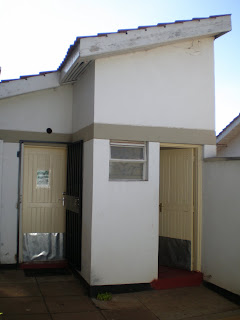
Our front "yard"...
There is a lovely "banda" on the grounds. That's Anne under there reading something or other.

Located at 7,000-ish feet above sea level and not far off the Equator, the weather in Eldoret is beautiful. A cool breeze takes the bite off the equatorial sun. The occasional cloud floats by... none were available for this picture.


Staggeringly less visually appealling are the sights on the wards. A combination of many things, not doubt, most obviously HIV & the lack of critical care resources leads to an all-too-common experience of watching young people die. I've never felt particularly drawn to critical care. I have often focused on its excesses at home. Just days into my time here, the other side of that coin becomes so very apparent.

A 20-year-old young man admitted comatose two days ago died yesterday with his family looking stoically on. We (I) never had much of an idea as to the nature of his illness. On rounds on the day of his death, we made plans to consult the ICU (All five beds full, refused an actual evaluation, I've yet to see this happen here), ordered two medications that I think we all new weren't available or wouldn't be administered anytime soon, and discussed a Neurosurgical evaluation that he would never be "stabilized" to receive. It was awful.

Other diagnoses aren't as challenging. A tension pneumothorax in a young man with pulmonary TB...
Miliary TB... a common theme thus far. And below, a follow-up CXR a few months after this miliary picture, showing fluid where it doesn't belong.


We are shortly headed to a place called Kerio View, boasting gorgeous views down into the Rift Valley for a date on Valentine's Day. We hope everyone is well.

Mom, be sure to log onto your Gmail account on Sunday morning so I can wish you a Happy Valentine's Day in person.

-Joe